
At first glance, this might seem like just another sports headline. But once you dig a little deeper, the situation feels far more layered.
The Unseen Impact
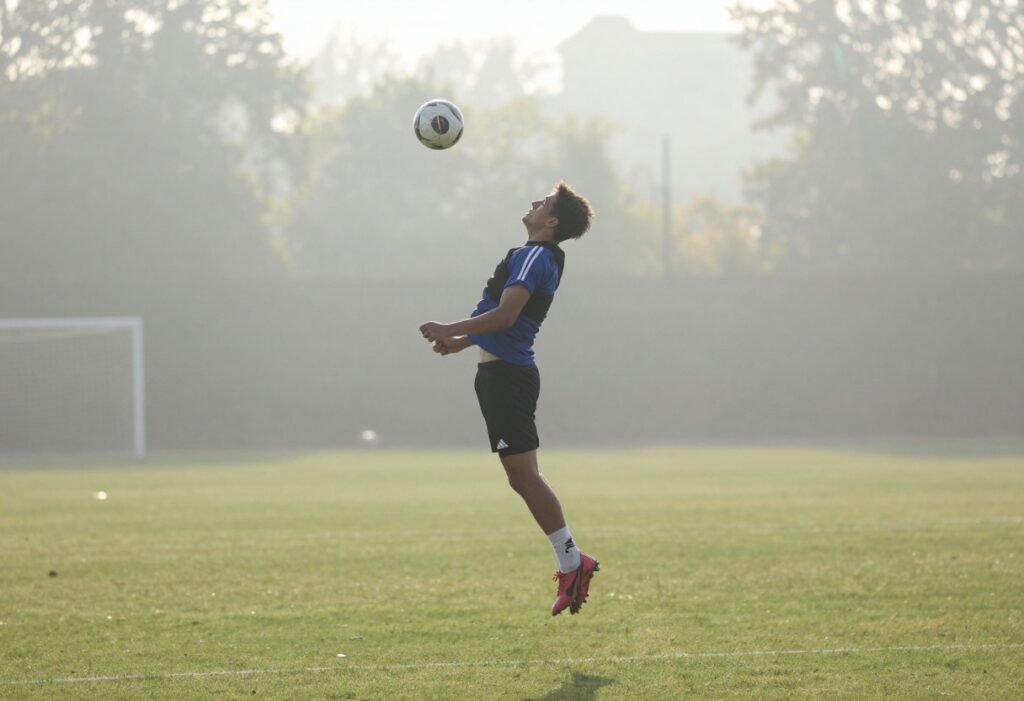
Let’s talk about something we’ve all seen a thousand times, maybe even cheered for. That moment of pure commitment—a player launching themselves, eyes fixed on the descending ball, meeting it with a solid, purposeful thud of the forehead. It’s fundamental. It’s brave. It’s, according to a growing pile of frightening research, quietly catastrophic for the human brain. I’m not here to scaremonger, but if you care about this sport, you need to listen up. The evidence linking repeated heading to neurodegenerative diseases like Alzheimer’s, Parkinson’s, and Motor Neurone Disease (MND) is moving from concerning to downright compelling. And the football world’s response? Well, it’s been about as coordinated as a Sunday league defence.
It’s Not Just the Big Ones
Here’s where our intuition fails us. We see the horror clashes, the sickening aerial collisions that leave a player concussed and staggering. Those are bad, obviously. But the real villain, the silent killer, might be the accumulation. The dozens, hundreds, thousands of seemingly innocuous headers in training. Every clearance from a goal kick, every flick-on from a throw-in. Each one delivers a sub-concussive impact. Think of it not as a single hammer blow, but as a constant, relentless dripping of water on stone. Eventually, it wears away. The brain, floating in its protective fluid, still sloshes against the hard interior of the skull with every jolt. It’s the repetition that does the damage, building up over a career that often starts in childhood.
You look at the legends of the game, and a pattern starts to emerge, doesn’t it? It’s anecdotal, sure, but it’s hard to ignore. Nobby Stiles, England’s 1966 World Cup hero, battled dementia for years before his death. His teammate and fellow midfielder, Sir Bobby Charlton, was diagnosed with it. Jeff Astle, the West Bromwich Albion centre-forward famed for his powerful heading, died with a coroner ruling his death was caused by repeated heading of a football—industrial disease. These aren’t random cases. They’re central defenders, target men, midfield generals. The players for whom heading wasn’t just a skill, it was a primary job requirement.
The Science is Getting Louder
What does the data actually say? A landmark Scottish study in 2019 was a real wake-up call. It found that former professional footballers were about three and a half times more likely to die from neurodegenerative disease than the general population. Let that sink in. Three and a half times. Goalkeepers, interestingly, had the same mortality rates as the public. Outfield players did not. The difference? You guessed it. The headers.
The mechanics are brutal in their simplicity. The brain’s white matter—the communication cables between different regions—gets stretched and damaged with each impact. This can disrupt everything from memory to motor function. There’s also the build-up of an abnormal protein called tau, which forms tangles inside neurons. This tau pathology is a hallmark of Alzheimer’s and other dementias, and it’s been found in alarming concentrations in the brains of deceased footballers who were known for their aerial prowess. It’s a physical trace, a scar left behind by the game they loved.
A Cultural Reckoning
So what do we do? Ban heading outright? For kids, absolutely, and many associations have. But for the professional game? It’s the heart of the sport. Imagine telling Virgil van Dijk he can’t attack a corner. Telling Erling Haaland he can’t power home a cross. It’s unthinkable. But doing nothing is becoming unthinkable too.
The solutions will be messy and incremental. We’re already seeing it. Limits on heading in training—maybe just a few purposeful drills per week, not endless crossing sessions. Better ball technology? Modern balls are lighter and don’t get waterlogged like the heavy leather bombs of the past, but they travel faster. Does that even help? I’m not convinced. The biggest change has to be in how we talk about it. We glorify “putting your head where it hurts.” We celebrate the player who gets clattered, gets stitched up, and comes back on. That culture of machismo is part of the problem. Reporting head injuries, taking a game off for dizziness—these things need to be seen as smart, not weak.
And what about the old guard? The players from the 60s, 70s, and 80s who are now facing these diagnoses? The sport has a moral duty to them. Proper support, proper care. This isn’t just about protecting the next generation; it’s about making right by the last one.
An Uncertain Future
Here’s the uncomfortable truth I’m left with. We love this sport for its physicality, its courage, its moments of sheer, brutal force. The header is a symbol of all that. But we’re now realizing that a core, celebrated element of the beautiful game carries a terrible, hidden cost. The science isn’t going away. The lawsuits, frankly, are probably just beginning.
The game will adapt. It has to. Maybe we’ll see a shift in playing styles—more technical, ground-based football. Maybe we’ll get smarter about monitoring and recovery. But every time you see a player rise to meet a cross, that little question will nag at you now, won’t it? We’re watching athletic brilliance, and we might also be watching a slow-motion public health crisis. The final whistle on this issue is a long, long way from being blown.
Football has faced scandals before—financial, political, even doping. But this feels different. This is the sport inadvertently harming its own, not through malice, but through ingrained tradition and a lack of knowledge. Fixing it won’t be easy. But acknowledging the problem, loudly and clearly, is the only place to start. The heads that won World Cups and league titles deserve that much.
This report draws on match reactions, player comments, and coverage from regional sports media.